
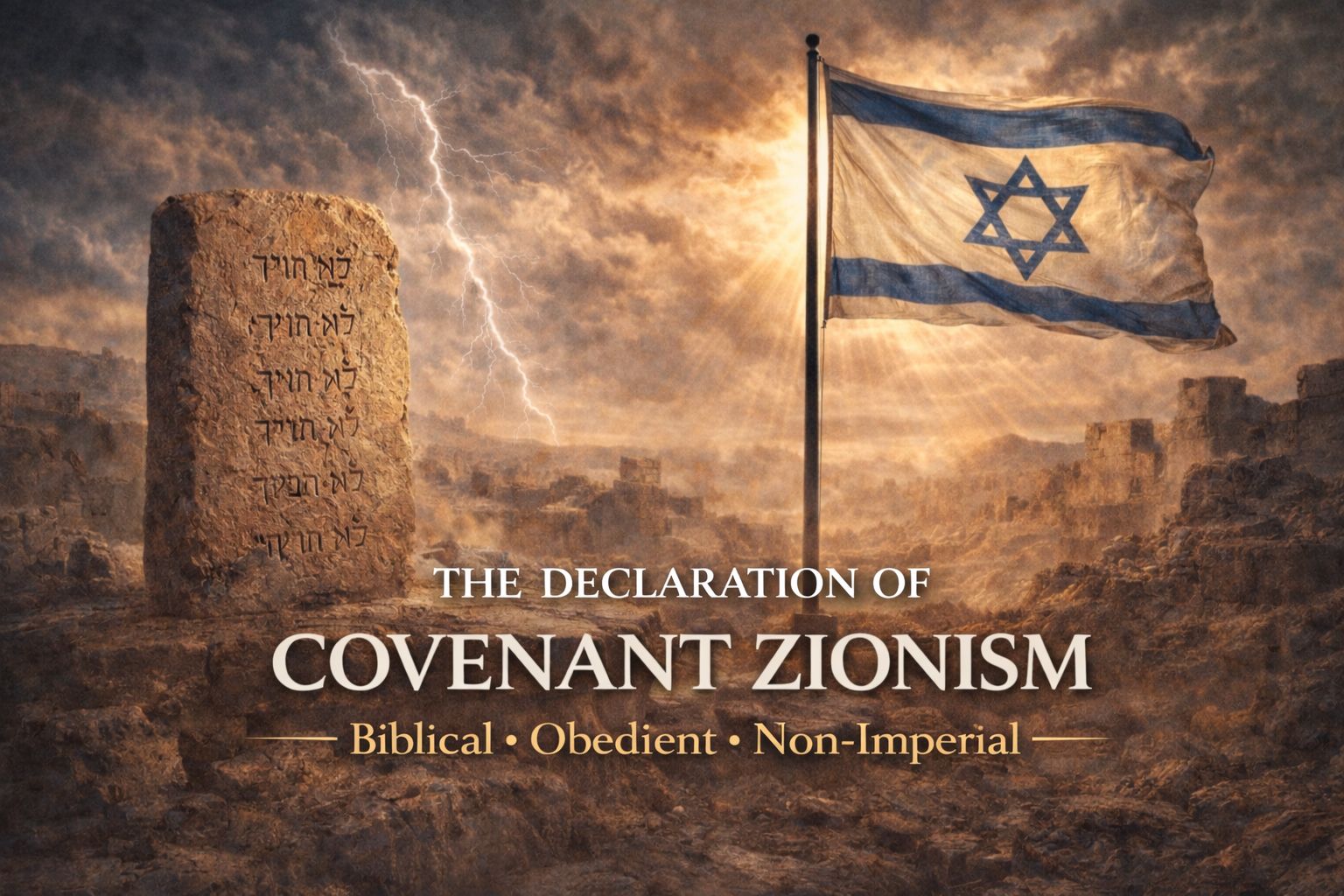
The Declaration of Covenant Zionism
Zionism is no longer a neutral word. It has acquired political, national, and ideological meanings so dominant that any invocation of “Zion” is now presumed to endorse a specific modern project of statehood, sovereignty, and power. This presumption is neither biblical nor inevitable. It is the result of historical capture.
Covenant Zionism must be named because silence has allowed a single narrative to monopolize a term that long predates modern politics. When Zion is spoken of today, it is assumed to refer to Political (British) Zionism or, by extension, to its Christianized variant—Christian Zionism—in which Christians adopt and defend a secular nationalist project as if it were a theological mandate. This default has erased alternative covenantal understandings and has rendered dissent morally suspect.
Naming Covenant Zionism does not introduce a new ideology. It restores a suppressed distinction. Zion existed in Scripture before it existed as a political program. It functioned as a covenantal symbol long before it became a geopolitical claim. To refuse to name Covenant Zionism is to concede that Zion belongs exclusively to modern power structures rather than to covenantal meaning.
This declaration therefore begins with definition, not demand. Covenant Zionism is articulated to clarify that when Zion is invoked, the question must be which Zionism is being referenced. Political Zionism is not the only framework. Christian Zionism is not the inevitable theological response.
Covenant Zionism governed by obedience, prophetic restraint, and divine timing stands as a distinct, non-coercive, covenant-centered understanding that refuses the conflation of faith with force.
Comparative Framework on Zionism Movements
| Dimension | Political (British) Zionism | Christian Zionism | Covenant Zionism |
|---|---|---|---|
| Primary Origin | Late 19th–early 20th century European nationalism; formalized through the World Zionist Organization and British imperial sponsorship | Modern evangelical Protestant theology, primarily post-1948 | Biblical covenantal tradition rooted in Torah, the prophets, Jesus Christ, and the apostolic Jewish community |
| Core Orientation | Jewish political sovereignty through statehood | Support for the State of Israel as prophetic or eschatological fulfillment | Covenant faithfulness, repentance, and obedience; Zion as covenant memory, not entitlement |
| Relationship to the Land | Land as political territory secured through legal mandate, settlement, and sovereignty | Land as a sign within a prophetic timetable | Land as historically meaningful but theologically subordinate to covenant obedience |
| Use of Force / Power | Accepts political coercion, military force, and state power as legitimate | Endorses state power instrumentally as fulfillment of prophecy | Explicitly rejects force, coercion, or entitlement as covenantal mechanisms |
| View of Jewish Identity | Often ethnic-national and administratively defined | Frequently adopts political definitions uncritically | Defined by covenant relationship with God, not race, nationality, or institutional approval |
| Treatment of Covenant Jews | Historically exclusionary toward nonconforming Jews | Often marginalizes covenant Jews by subsuming them under secular Zionism | Affirms covenant Jews as legitimate heirs to Jewish covenant identity |
| Relationship to the State of Israel | Constitutive and foundational | Supportive and deferential | Respectful but non-identical; does not equate state authority with divine mandate |
| Zion as Concept | Territorial and sovereign | Prophetic and geopolitical | Spiritual, covenantal, and ethical |
Zion as a covenant concept
Zion is not a slogan or entitlement. Scripture ties restoration to repentance, obedience, and God’s declaration—not to conquest, empire, or legal decree.
Not political Zionism
Political Zionism is a modern project operating by imperial access, administrative recognition, and military enforcement. Covenant Zionism does not derive authority from those mechanisms and rejects equating political success with covenant fulfillment.
Not Christian Zionism
Covenant Zionism rejects speculative fulfillment and any attempt to accelerate prophecy. Waiting and restraint are marks of covenant fidelity.
Affirmations
- Zion belongs to God alone.
- Restoration is repentance-conditioned and God-initiated.
- No human authority may declare covenant fulfillment.
- Covenant faithfulness waits until God speaks.
Rejections
- Sanctifying conquest or displacement in God’s name.
- Using protected doctrine to silence covenant critique.
- Treating territory as proof of divine favor.
Until God speaks, Covenant Zionism waits.